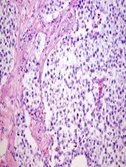
Q32. A 25-year-old male presents with a painless, progressively enlarging swelling in the right testis. There is no history of trauma or infection. H&E stain of the excised mass shows the below findings. What is the most likely diagnosis?
Tap an option to reveal the answer
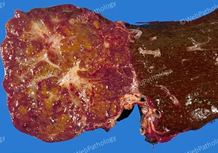
Q34. The gross specimen of a liver mass excised from patient is shown below. Based on the image findings, what is the most likely diagnosis?
Tap an option to reveal the answer

Q31. An elderly male presents with progressive cervical lymphadenopathy and increased bleeding tendency. Peripheral blood smear shows >25% blasts, cytochemistry reveals MPO positivity, and the findings shown below are consistent with this condition. Which of the following cytogenetic abnormalities is most likely associated with it?
Tap an option to reveal the answer
Q33. A 50-year-old female presents with a firm thyroid swelling. FNAC reveals marked cellular pleomorphism with variation in cell size and shape. Histopathology shows amyloid deposition in the stroma. Immunohistochemistry is TTF-1 negative, positive for chromogranin and synaptophysin. Which of the following is the most likely diagnosis?
Tap an option to reveal the answer
Q35. An elderly male presents with bilateral cervical lymph node enlargement. Immunohistochemistry reveals CD10 positive and BCL2 positive cells. Which of the following cytogenetic abnormality is commonly associated with this condition?
Tap an option to reveal the answer
Q36. Which of the following programmed cell death mechanisms are caspase-dependent?
Tap an option to reveal the answer
Q37. 6-year-old child presents with pallor, jaundice, and splenomegaly. The child has a history of intermittent anemia since infancy. Laboratory investigations reveal low hemoglobin, elevated reticulocyte count, elevated MCHC. On further questioning, it is revealed that the father had similar symptoms in childhood. Which of the following is the most likely diagnosis?
Tap an option to reveal the answer
Q38. A 35-year-old patient presents with progressive vision loss, more prominent in the temporal fields. MRI brain reveals a suprasellar mass compressing the optic chiasm. Histopathological examination of the excised lesion shows 'wet keratin' and stratified squamous epithelium. Which of the following is the most likely diagnosis?
Tap an option to reveal the answer
Q39. Which of the following technique is most commonly used to compare and quantify CD markers on immunophenotyping?
Tap an option to reveal the answer
Q44. An elderly female is found unconscious with frothy sputum and is brought to the emergency room. On evaluation, she is noted to have tachypnea, basal crepitations, and bilateral pedal edema. Chest X-ray shows pulmonary congestion, and a lung biopsy reveals hemosiderin-laden macrophages. Which of the following conditions is least likely associated with this histopathological finding?
Tap an option to reveal the answer
Q1320. precipitated by exertion and dehydration. Examination reveals pallor and mild splenomegaly. Laboratory investigations show hemoglobin of 8 g/dL with normal MCV, indirect hyperbilirubinemia, and a reticulocyte count of 6%. Peripheral blood smear is shown. What is the most likely diagnosis?
Premium Question
Unlock to see the answer & explanation
Q1472. A chronic tobacco user presents with a non-healing ulcer on the lateral border of the tongue. An image of the lesion is shown. What is the most appropriate biopsy for diagnosis?
Premium Question
Unlock to see the answer & explanation
Q1325. Patient complains of headache is being evaluated and found to have a brain tumor. HPE reveals tumor composed of Antoni A and B areas. Which among the following s an IHC marker positive in this tumor?
Premium Question
Unlock to see the answer & explanation
Q1326. 11 A biopsy slide shows a granulomatous lesion in a patient with langerhan cell histiocytosis . Which of the following cytokines is primarily responsible for maintaining granulomas by activating macrophages?
Premium Question
Unlock to see the answer & explanation
Q1335. A kidney transplant recipient on long-term therapy presents with blisters and a non-healing ulcer on sun-exposed skin, which is diagnosed as squamous cell carcinoma. Which of the following factors is most likely responsible for the development of this malignancy?
Premium Question
Unlock to see the answer & explanation
Q1395. A 60-year-old chronic tobacco chewer presents with a non-healing, ulcerated, round lesion at the angle of the mandible. Examination reveals an ulceroproliferative lesion, and biopsy confirms squamous cell carcinoma. Laryngeal crepitus/ sign is absent. What is the most likely primary site of this cancer?
Premium Question
Unlock to see the answer & explanation
Q1414. According to Biomedical Waste Management Rules, in which type of disposal bag should the following be discarded?
Premium Question
Unlock to see the answer & explanation
Q1431. On World Cancer Day, a screening camp was conducted for cervical cancer among 1,000 women. 1 woman was detected positive during the screening. This type of prevention represents:
Premium Question
Unlock to see the answer & explanation
Q1443. history of endocrine tumors, and genetic counseling is advised on labs, calcium is raised. The clinician plans further evaluation to identify associated inherited syndromes and guide family screening. Which of the following statements regarding this condition is correct?
Premium Question
Unlock to see the answer & explanation
Q1463. and not fixed to the chest wall. There are palpable ipsilateral axillary lymph nodes. There is no evidence of skin involvement, chest wall fixation, or distant metastasis on clinical examination and imaging. What is the most appropriate stage of carcinoma breast?
Premium Question
Unlock to see the answer & explanation