Q10. During breech delivery, the attending observes winging of the scapula and performs a maneuver. Identify the maneuver.
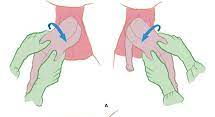
Tap an option to reveal the answer
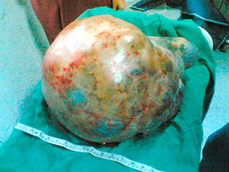
Q46. A 35-year-old female presents with lower abdominal pain and abdominal fullness for the past 2 months. Ultrasound reveals a unilateral ovarian cystic mass. Her CA-125 levels are mildly elevated. Surgical excision of the mass is performed and the gross specimen is shown below. Which of the following is the most likely diagnosis?

Tap an option to reveal the answer
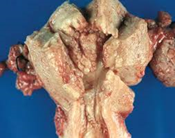
Q13. A 65-year-old woman presents with postmenopausal bleeding. Hysterectomy is performed and gross specimen is shown. What is the most likely diagnosis?

Tap an option to reveal the answer
Q14. A P2L2 woman with a history of difficult vaginal deliveries conducted by a dai presents with the following condition. Injury to which of the following ligaments is most likely responsible?

Tap an option to reveal the answer
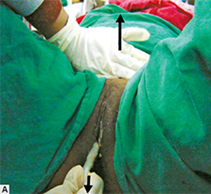
Q16. During a normal vaginal delivery, an intern is asked to identify the maneuver being performed. What is the correct response?
Tap an option to reveal the answer

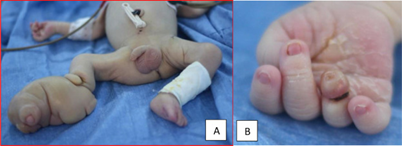
Q21. A newborn presents with limb deformities shown below. Based on the image shown, what is the most likely diagnosis?

Tap an option to reveal the answer
Q1. What is the total loading dose of magnesium sulfate in Pritchard's regimen for eclampsia?
Tap an option to reveal the answer
Q2. A 32-year-old P2L2 woman presents with 6 months of secondary amenorrhea. Laboratory evaluation shows FSH: 36 mIU/mL, LH: 56 mIU/mL, and AMH 0.05 ng/mL. What is the most likely diagnosis?
Tap an option to reveal the answer
Q3. A 28-year-old woman in active labor with regular uterine contractions. On per vaginal examination, her cervix is 8 cm dilated. A pulsating umbilical cord is felt below the presenting part. What is the most appropriate immediate next step in management?
Tap an option to reveal the answer
Q4. In the repair of a mediolateral episiotomy, what is the correct order of tissue approximation during suturing?
Tap an option to reveal the answer
Q5. A woman with 2 months of amenorrhea presents with a positive urine pregnancy test, enlarged breasts with Montgomery tubercles, linea nigra, bluish discoloration of the vaginal mucosa and uterine enlargement on bimanual examination. These findings are best categorized as:
Tap an option to reveal the answer
Q6. A G2P2 woman with a history of previous lower segment cesarean section is in active labor. She suddenly develops fetal bradycardia, maternal tachycardia, and severe suprapubic pain during contractions. On examination, the cervix is 6 cm dilated, and the fetal head is at -1 station. What is the next best step in management?
Tap an option to reveal the answer
Q7. Hydronephrosis due to carcinoma cervix is seen in which FIGO stage?
Tap an option to reveal the answer
Q8. A woman develops atonic postpartum hemorrhage that does not respond to initial management and medical therapy. What is the next best step that can be performed in the labor room?
Tap an option to reveal the answer
Q9. A primigravida undergoing vaginal delivery delivers the fetal head, but the shoulders fail to deliver. What is the correct sequence of maneuvers in managing this obstetric emergency?
Tap an option to reveal the answer
Q11. An elderly woman presents for routine check up, on examination blood pressure of 170/100 mmHg is recorded and she also complains of blood-stained vaginal discharge. What is the most appropriate next step in her management?
Tap an option to reveal the answer
Q12. A 46-year-old nulliparous woman presents with abnormal uterine bleeding. Transvaginal ultrasound shows endometrial thickness of 24 mm. What is the next best step in management?
Tap an option to reveal the answer
Q15. A 32-year-old woman with a BMI of 38 undergoes lower segment cesarean section at 35 weeks gestation due to preeclampsia. Which of the following is the most appropriate pharmacological agent for deep vein thrombosis prophylaxis in this patient?
Tap an option to reveal the answer
Q17. A 24-year-old primigravida at 36 weeks gestation presents with complaints of no fetal movements for the past 24 hours. A non-stress test is performed and shows one acceleration in 20 minutes with no fetal decelerations. What is the next best step in management?
Tap an option to reveal the answer
Q18. A pregnant woman in her first trimester presents with lymphadenopathy. There is a positive history of Toxoplasmosis infection 2 years ago. Her current serology shows Toxoplasma IgG positive. What is the most appropriate next step in management?
Tap an option to reveal the answer